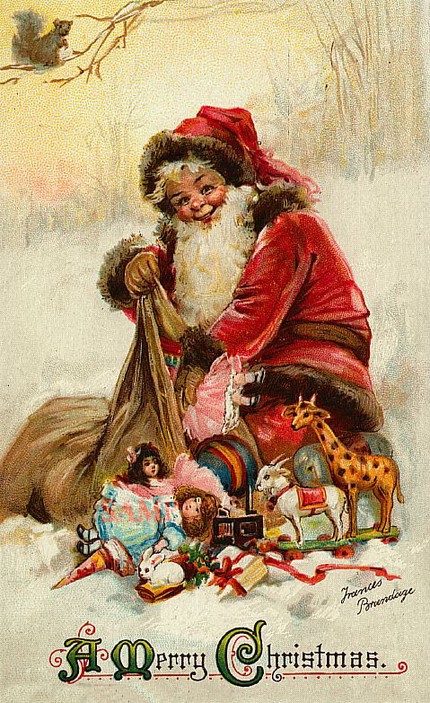
Showing posts with label Christmas. Show all posts

Friday, December 2, 2011

You better be good or Santa won't come: what we are teaching our children about possessions and worth


For the next four weeks, children all over the world will be hearing those words, "If you're not good, Santa won't come." I doubt it makes any difference to behaviour. The problem with threats like these is they're rarely (if ever) carried out. But it might just be making a difference to how people think about possessions and worth.

Imagine a child called Trudy. At the ripe old age of 7, Trudy has learnt that, no matter how badly behaved she is, those presents from Santa still arrive on Christmas Day. Furthermore, she knows that Jenny from next-door (also aged 7) usually gets less presents even though Jenny is a very well-behaved child and Trudy can be quite naughty at times. What is Trudy to make of this?

Or let's look at it from Jenny's perspective. She is told that the same Santa Claus brings presents to everyone. Furthermore, she is told that he only gives presents to the good girls or boys. So why is it that Trudy gets more presents than her? I doubt she would say it to herself in these terms, but on some subconscious level, might she not be wondering whether she is less worthy than Trudy in some unknown way? If she believes the Santa rhetoric, what else is she to think?

Let's fast-forward six years. Trudy and Jenny are now 13. Their belief in Santa has gone, but the messages they heard about Santa are still there. As any psychologist or counsellor knows, the messages we hear in childhood can affect us long after we have grown up - even if we recognise that those messages were false to begin with.

If you haven't already guessed, Trudy comes from a wealthier family than Jenny. So while they may not be coming from Santa, Trudy still has more and better possessions than Jenny does. Jenny knows it's not because Santa has placed Trudy on the "good list". But maybe, deep down, she still connects possessions to worth. Maybe she still feels like Trudy owns more things because she is more deserving.

Jump another 10 years. Trudy and Jenny have moved out of home and are sharing a flat together. Trudy finished uni and got a well-paid job. Jenny also has a job, but it's not nearly as well-paid as Trudy's is. By now, they've not only internalised the Santa message, but the many advertising messages they have heard through their lives that tell them, either implicitly or explicitly, that they should buy something because they deserve it.

Despite the fact that Trudy earns enough to save a little money and use her money to help others and give to charities, she spends it all on herself. Many of the things she buys, she will never even use. But that's okay (in Trudy's mind). It makes her feel good. She's become her own Santa, rewarding herself with possessions. The more things she owns, the more deserving she feels.

Jenny also buys lots of things. But because she doesn't earn as much money as Trudy, she puts it on credit. She is sliding further and further into debt. But she considers it a small price to pay for the sense of self-worth it gives her. She has finally made it onto Santa's "good list".

Jenny was never any less worthy than Trudy. She only felt that way because of what society told her. As adults we know that the amount of presents Santa brings says nothing about how "good" that child is. So how about we stop telling our children that. And how about we recognise the Santa messages we ourselves have internalised - and do our very best to get rid of them.

Our thinking about possessions and worth is damaging not just to ourselves, but to the earth. In order for this to change (and it does need to be changed) we first need to recognise how the messages we hear have influenced the way we think about possessions and worth. It's only then that we can get rid of them and replace them with something else. We need to come up with a new message, one where Santa doesn't reward the "good" kids, where we don't own things because we "deserve" them, but where a life well-lived is its own reward.

Friday, December 10, 2010

The danger of ordering Christmas presents online

I just wanted to alert everyone to the danger of ordering Christmas presents online, to be delivered.

I have ordered all of my Christmas presents for my sons online. One son had a bag from one place and a whole heap of Dr Who stuff from another place. Those two parcels consisted the majority of his Christmas presents this year, besides some minor ones and a big one for the family.

Well according to Australia Post, those two parcels were delivered to me at 5:30 on Thursday. I was home at 5:30 on Thursday and no parcels were delivered at that time. Not only was I home, but I was in the loungeroom, with a direct view out of the window. Plus my dog barks like crazy when someone pulls up, so he would have soon told me if the postal contractor was there. When I'm in my study, I know a parcel is being delivered because my dog lets me know. And at that time, I was actually looking out for the parcels as well. According to Australia Post, I signed for these parcels. I did not sign for these parcels.

I’m not sure what happened. Maybe they were delivered to the wrong address and the person there decided to sign for parcels that were not theirs. If so, they stole a child’s Christmas presents. Or maybe it was delivered at another time and decided to give it to some random person who just happened to be in my yard. Again, if so, that person stole a child’s Christmas presents.
 
I’ve rang up one of the merchants I bought from. And they are very nicely sending me a replacement. The parcel containing all the main presents for my son was bought from PopCultcha. I only just discovered that that parcel was also apparently delivered on Thursday. I've just sent them an email and am waiting to hear back from them.

But Australia Post refuses to do anything because they say they were delivered. When I know full well they were not. At least not to me.

Now I’m facing the possibility that my son may have no Christmas presents this year. I can’t afford to get new ones. It was hard enough affording the ones I bought.

And I am really upset about this. Not to mention worried about the presents I ordered for my other son. I’m also worried that perhaps that were other parcels that may have been delivered at the same time that were not tracked. I won't know they're missing until they never turn up, I suppose.

My son’s are 11 and 9 years old. One still believes in Santa. I really don’t want to have to tell them that there’s no Christmas Presents this year because Australia Post failed to deliver them to the right person.

My son asked me the other day if Santa was real. I told him that if he believes in Santa, then Santa exists.

Well at least he did. But I have a terrible feeling that Australia Post just killed him.

Monday, October 11, 2010

October Scrooge

As soon as October rolls around, I start to get that old Scrooge feeling again.

Now I love Christmas - In December. Or the first seven days of January. Or even in July, because the whole seasonal thing of Christmas in July when you’re living in Australia is kind of nice.

But as for Christmas in October - bah, Humbug!

The Christmas items seem to make their way to the stores earlier and earlier each year. We’re not exactly flooded with Christmas products at the moment, but they’re coming out. Warning us that we better buy up quick because Christmas is only - over two months ago. I would add up the days to get a precise figure, but I’m too anti-Christmas in October to even do that.

Of course, it makes sense for businesses to put out their Christmas products as soon as possible. The sooner they’re out, the sooner people will start thinking about all the Christmas buying they have to do. They sooner they start buying things for Christmas, the more they’re going to buy. People who wait until the last minute to do their Christmas shopping rarely go overboard.

But it’s so annoying.

For one, Christmas is not meant to be about buying stuff. And we get so caught up in the whole Christmas buying thing that it makes us stressed and time poor. Instead of spending time with the people we love, we’re out buying them gifts.

But there’s another reason why I hate Christmas in October. We get sick of Christmas before it’s even here. And it ruins the excitement of seeing those Christmas products at Christmas.

I remember when seeing Christmas decoration and products really brought a thrill. Because when they arrived in the stores, you knew that Christmas was just around the corner. Now, by the time Christmas is just around the corner, we’ve been looking at Christmas products for two months. And it’s just not that exciting anymore.

Plus, we’re so over Christmas by the time it gets here, that we have that one day and forget all about it. Christmas should be celebrated after the actual day, not just before it. It’s not meant to be about - got my gifts, great, now let’s start planning for Easter.

Christmas is a very special time of year. It should be about Jesus, about tradition, about family, about love. Instead, we’ve turned it into a three-month shop-a-thon. And the earlier those Christmas products go out onto the shelf, the less Christmas is about like Christ.

Thursday, January 7, 2010

Ukrainian Christmas - Tradition and Connection to the Past


Happy Orthodox Christmas.

I am half Ukrainian and so today was kind of my Christmas – or my second Christmas, as I used to say when I was a child. Many of my friends used to think I was incredibly lucky to have two Christmases instead of one – that is until I told them that Santa Claus didn’t come twice. Despite that, I think I am lucky. Not because I have two Christmases. But because Ukrainian Christmas is one of my favourite times of year.

Our Ukrainian Christmases (as I believe is the case for Christmas in the Ukraine) was very focused on tradition. We had a number of things that we did every year. This included having a 12 course meal on Christmas Eve, which started with a dish made from poppy seeds called kutya. Some of the other children detested this dish. But tradition was that you had to eat at least some of it. So they would take the tiniest bit possible – and still take double as long to eat it as everyone else. I didn’t mind the kutya. But there were dishes I did not like. And you were meant to eat a little bit of at least each dish. (Mind you, the rules were not too strict on this, as my English mother did not like many of the dishes on the table. Plus, another tradition was that the dishes must be vegetarian – which for Ukrainian cooking means a lot of cabbage. And my mother cannot eat a lot of cabbage. So as she couldn’t eat every dish, she didn’t make us eat every dish either.

Despite the relaxed rules, it was hard to avoid eating a lot, with my grandmother constantly telling people to eat. Even the dead had food put in front of them. On the table there was a candle, with photos of those who had passed away leant against it. A plate was put in front of these photos so that a meal could be given to them as well.

The reason I am speaking in past tense here is because my grandmother is now too sick to prepare the Christmas Eve meal. And unfortunately, there are many Ukrainian dishes that I may never eat again. I know I will never have a Ukrainian Christmas Eve meal again.

But anyway, this isn’t a post about how much I miss my grandmother’s cooking. It is a post about tradition and connection to the past.

I have never been to the Ukraine. I may never go. Yet there is a very strong connection between me and that country. Not just through blood – although this is part of it. But through tradition. For every Christmas and every Easter, I would do the same things, eat the same food and hear the same words as the people in the Ukraine were doing now and had done for many years.

And that creates a bond. A bond cannot be formed by simply being part of a family or sharing a common interest. A bond is formed through doing the same things together. And even if I am on one side of the world and someone else is on the other, there is a bond between us, for we share the same traditions and practices.

One thing that I continue to do is go to the Ukrainian Christmas Mass. There was a part of me that loved the Ukrainian Christmas Mass when I was a child and part of me that couldn’t stand it. Because it is all in a different language. Although I started learning Ukrainian as a child, my father insisted I give it up. He thought it was not a useful language. Today I took my children to Ukrainian Mass for the first time. My son turned to me at the beginning and said ‘I don’t understand what he’s saying.’ I said, ‘That’s okay. Neither do I.’

I wish I did. For I disagree with my father. Ukrainian is a useful language. Maybe not for getting a job or achieving success. But it is useful nonetheless. For it would be one more connection with the Ukraine. It would be another bond between me and the country where my father and grandparents came from and my ancestors lived for centuries. It is not only success in the present that is important. Connection to the past is also important.

Yet despite not understanding it, it is still a beautiful Mass. And perhaps even more beautiful for the fact that I do not understand it. I must simply be there. And sometimes I think we place too much emphasis on thinking, and not nearly enough emphasis on just being present in God’s presence.

It’s hard to say why a connection to the past is important. I can’t present you with a detailed argument that follows each point to a logical conclusion. But I’m not sure that the benefits of tradition are meant to be presented in such a way. Tradition, connection to the past, is not one side of a debate. It is simply part of us. None of us should be isolated beings, suspended in mid-air and mid-time. We are connected, both to the past and to the future. We are also part of something that is bigger than ourselves. And to understand those connections, to embrace them and to recognise their importance is to gain a better understanding of who we are. Rather than trying to prove that, maybe we should simply accept it.

Christianity also has many traditions. And some may say that those traditions are not important. But like the traditions of Ukrainian Christmas, those Christian traditions also remind us that we are connected to something. We are connected to the past. We are connected to the present. We are part of something larger than ourselves. When we celebrate the Lord’s Supper, we are not just doing something in memory of what Jesus did, a long, long time ago. We are spiritually connected to that event. We also form a bond with all the people who have celebrated the Lord’s supper, all around the world, both here and in the future.

Oftentimes people want to get rid of tradition because they see no reason for it. Unless it serves some practical purpose, why bother doing it? A bit like my father telling me I shouldn’t learn Ukrainian. But it is not only things that have a practical purpose that are of value. Sometimes the most valuable things are those that are not ‘practical’ at all. Then again, maybe they are practical, but just not in the way that the world defines practical. They may not do much to feed our bodies, but they do a lot to feed our soul.

Here is a picture of the Ukrainian Church I went to today. There was a beautiful picture of Mary and Jesus on the table, but unfortunately they changed it before I had a chance to take a picture.


Here is a picture of my sons and me outside the church. The one with the grumpy face is the one who complained that he couldn't understand the service.


And here is a Ukrainian Christmas Carol. If you don't understand what is being said, don't worry, neither do I.

Sunday, December 27, 2009

Not a Good Christmas

I hope you had a nice Christmas. I didn’t.

It started with me being woken at 5 o’clock in the morning, when I heard my youngest son, sounding very upset, telling his brother ‘We have to tell Mummy’. I raced out of bed, not sure what was happening, but knowing that something was definitely wrong. What was wrong was that my youngest son was sick and felt like he was about to throw about. Actually, it wasn’t as bad as what I had envisaged. But still, not a good start to Christmas.

He actually got better and then my eldest son got sick. He spent practically the entire day in bed with a headache and a high fever. At one point, he kept crying and crying because his head hurt and he couldn’t get to sleep. My friend rang me just as I was trying to get the fever down and I think it’s the quickest conversation I have ever had with her.

I missed Mass. And from about 10 o’clock to 12 o’clock, I was quite upset about it.

I cooked a beautiful Christmas lunch that cost a lot of money and a lot of time, and I was practically the only one eating it.

I had planned to sing Christmas carols with the boys after lunch, and it ended up being my youngest son and I singing about three carols and then giving up.

Not really a good Christmas.

And yet, in a strange way, it was probably the most peaceful Christmas I have ever had.

Because the pressure was off. There was no way this was going to be a perfect Christmas or even a good day. It had gone wrong right from the start. And so suddenly, it didn’t matter if other things went wrong.

I think sometimes there’s a lot of pressure on us to get Christmas right. Christmas will be the day we really focus on Jesus. Christmas will be the day we cook the perfect meal. Christmas will be the day that everybody eats what’s put in front of them. Christmas will be the day when everybody is selfless and generous. Christmas will be the day that we do a superb job of loving each other. Christmas will be the day that we do not fight.

And usually, something does go wrong. And then we get upset, because Christmas is not perfect anymore. And then we get angry because things aren’t happening the way we want them to.

The truth is it’s important to focus on Jesus every single day of our lives. It’s important to show our love for each other every single day of our lives. Christmas is important. But it shouldn’t be the day when we make up for a year’s worth of neglect. It should be the day when we continue to do what we have been doing all year.

When everything started going wrong this Christmas, I kept thinking that I have another year before I can try and make it up somehow. But that’s not really right. I may need to wait another year for Christmas presents to be given again. I may need to wait another year before I can cook another Christmas lunch - although the way things are at the moment, I could still have some of this year's leftovers. I may need to wait another year before it’s that special time when we remember Christ’s birthday. I may need to wait another year before I can go to a Christmas Mass. (Actually, that’s not strictly true, because I do go to the Ukrainian Christmas Mass on January 7th. But still, another year before I can go to Christmas Mass in the Roman Catholic Church.)

But every day is a good day to remember Jesus. And every day is a good day to give the gift of ourselves to others.

Wednesday, December 23, 2009

Christmas is About Hope


Every Christmas, I go on a mini crusade against too much consumerism, too much Santa, too much stress and too little Christ. It’s not much of a crusade, because I’m just as guilty of those things as anyone else. Perhaps even more so. I guess I feel that, if I complain about it, it will somehow make me feel better. So as I shout out Merry Christmas to the world, I add a PS – But you’re getting it all wrong. Despite the fact that I’m getting it wrong myself.

Christmas should be a time of love, joy, peace and hope. I’ve turned into an excuse to point out the world’s faults.

I tend to point out the world’s faults quite a bit. I love to wag my finger at the world and say you’re getting it all wrong. I don’t do this because I need a hobby and finger-pointing seemed like an inexpensive one to choose. I do this because I do really believe that the world gets it terribly wrong sometimes. We place emphasis on materialism and success and downplay love and sacrifice. We judge things by scientific facts and evidence, and lose our ability to appreciate mystery and the sacred. But anyway, this is not meant to be another post about what’s wrong with the world.

And when I say the world has got it wrong, I include myself in that. I have it wrong just as much as the world does. Christ is so important in my life – at least that’s what I say – yet there are many occasions, each and every single day, when I fail to show that he is important. I do the things I don’t want to do and I fail to do the things I should be doing. The way I live is so far from the way I actually want to live.

When I look at how the world gets it wrong, I sometimes get angry. My children are pretty used to suddenly seeing me argue with the TV, when I’ve heard something on the news that I disagree with. Now, they’ve even started doing it themselves.

Sometimes, though, I just get depressed. This is particularly the case when it comes to my own faults. It is hard to continually feel as though I am failing in what I want to do.
Sometimes the situation just seems hopeless. The world has got it so far wrong that it seems impossible they will ever get it right. The problems are too big. People’s attitudes are too wrong. And my own life seems like a never-ending attempt to live the right way and never getting there. It just can’t be fixed. Why even bother trying?


But then Christmas comes and with it comes a message of hope. I’m sure you know that Christmas is not just about Santa and presents. But it’s not even just about Jesus being born. It’s about God’s Son being born. It’s about God taking on human form. Not so that He could have a short trip to Earth for a while to see what it was like. But because we were in a hopeless situation and we needed help. We were never going to get it right. We were never going to be good enough. So instead of giving up hope on the whole human race, God did something truly amazing. He sent his Son to give hope to the whole human race.

Recently, a boy was sent for psychological evaluation, after his teacher asked him to draw a picture of what Christmas meant for him and he drew a picture of Jesus on the cross. (I didn’t see this on the news, but I was arguing with my computer for a while. Why does the world get it so – oh, forget it.) At the risk of having my son sent in for psychological evaluation too, he made the same mistake. The other day he said, ‘Christmas is not about Santa. It’s about Jesus dying on the cross.’ My eldest son laughed in his ‘I’m an older brother and so much smarter’ laugh and said, ‘Christmas is not about Jesus dying on the cross. It’s about Jesus being born.’ But I told him that Christmas is about Jesus dying on the cross. It’s also about Jesus’ resurrection. Because the ending is what makes the beginning so special. At Christmastime, we must not only remember that Jesus was born, we must remember why He was born.


I have no idea how to fix the world’s problems. I have no idea how to put us on the right track again. I have no idea if we can be put on the right track. I don’t even know how to fix the problems in my own life. If I needed to work it all out, we may as well give us hope now. For I don’t know any solutions – beyond arguing with TVs and wagging my finger at the world.
There is one thing I do know though, one thing the Christmas story tells me, one thing the life of Jesus shows me and one thing Jesus’ death and resurrection makes real in my life – When things seem absolutely hopeless, God works in incredible and unimaginable ways to replace that hopelessness with hope.


Image details: Adoration by the shepherds, by Bronzino. From Wikimedia Commons. Image is in the public domain.

Friday, December 18, 2009

New Zealand Billboard of Mary and Joseph

One item of news that received a lot of internet discussion lately is the billboard a New Zealand church put up, of Joseph and the Virgin Mary lying in bed and Mary saying God was a hard act to follow. I refuse to put up a picture of this billboard, even though I’ve seen it on at least different articles so far. If you really want to see what I’m talking about, do a Google search and I’m sure you’ll find it. One man disliked the billboard so much that he attached it with a can on brown spray paint. I can’t say I blame him!

The billboard was placed outside St Matthew in the City. The Vicar, Glenn Cardy, apparently wants people to discuss God. Now I’m all for people discussing God. And I don’t limit that to discussions that I find acceptable. I’m quite comfortable when people say bizarre things about, or even show a complete lack of respect for God. Not that I don’t think God should be respected. I believe he should. But considering the lack of respect the world has for anything, it’s pretty understandable that some people believe God doesn’t deserve our respect either.

But when that disrespect comes from a church, I find that deplorable.

As I said, our world is not very respectful. We’ve lost the respect for authority figures we once had. And we regularly make fun of people, like the Prime Minister, in television shows and newspapers, for example. But imagine this. What if the people in the Labor Party started making fun of the Prime Minister? What if they started drawing pictures of him that drew attention to real or make believe flaws? Wouldn’t you kind of say – hold on. It’s okay for us to make fun of him. But you’re on his side.

There are quite enough people making fun of God without the Church coming in on the act. And why on earth should other people respect God – or at the very least, respect our beliefs – if we make fun of God ourselves?

That’s not to say that we can’t have a joke. I enjoy a fair bit of religious humour. I particular like humour that pokes fun at Christians. And I will say the odd joke or two that involves God or Jesus. But in all my humour, there is still respect. I like to tell jokes that involve God, when I think he’d laugh along with me. I prefer to laugh with God rather than at God.

And perhaps the point could be argued that this Church thought they were laughing along with God. Maybe they thought God got a good old chuckle out of it. I don’t think His sense of humour is that warped myself.

And despite all our disrespect and our desire to laugh at anything at anybody, surely there must be boundaries that should not be crossed. There must be something in our world that we hold sacred, that deserves not only our respect, but our reverence and awe. And Christmas is a time when we should be filled with awe. For God came down to earth in human form. Now Santa Claus coming through the chimney when you live in the middle of a high rise apartment building might be impressive. But God taking on human form, God entering earth as a human baby, that beats Santa Claus’ chimney sliding act hands down.

According to Glenn Cardy, most Christians do not believe that Mary was impregnated by God. I’d like to know what Christians he talks to. Most of the ones I know have a pretty solid belief in the incarnation. And they’re not the kind of Christians who believe it is the sort of thing that should be made fun of.

This idea of generating discussion about God is a good one. But at what cost? Sometimes it seems that it’s our excuse for everything. Well, we’re just trying to get people to talk about God. But we should make sure that when people are discussing God, that they’re not influenced by a whole lot of warped ideas and bad jokes. And we should also make sure that what initiates discussion amongst non-believers doesn’t cause some Christians to doubt their faith.

What if the people who do have faith start thinking losing their sense of God’s holiness? What if they start thinking he doesn’t deserve our awe and respect? What if Christians start thinking of God as just another figure of fun? And why bother following a God like that?

In these days of political correctness, Christmas has belong the holiday of nothing special at all. Instead celebrating the most event that ever happened, we have stripped it of all meaning. We think about presents, instead of the Incarnation. We look forward to when Santa will come to our houses, instead of thinking back to when God came to earth. We’re not allowed to mention Jesus or Christ or even Christmas, in case it happens to offend somebody. And yet billboards that poke fun of Mary and Joseph are quite okay. I guess it’s okay to mention religion – and offend a whole lot of people – just as long as you’re not respectful. And it’s okay to offend people, just so long as they’re the one group of people to whom Christmas actually still means something important.

Friday, December 11, 2009

Make Room for Christ at Christmas - or - Why Santa Should Be Sent to the Dog Kennel


Yesterday, I posted one of my short stories called No Room. Although I’m pretty sure the historical details aren’t entirely correct, I wrote it that way because I wanted to write a story about someone who finds it hard to make room for Christ at Christmas.

In Bethlehem, over 2000 years ago, it was hard to find a place for the Baby Jesus to be born. In the 21st Century, we are still finding it hard to make room for Jesus in our lives.

Ironically, one of the hardest times to make room for Jesus is at Christmas, the time when we should most be thinking of him. Instead of preparing a room and welcoming him as an honored guest, we treat him as an inconvenience – and one we don’t have time for right now.

Everybody is so busy at Christmas. There’s the Christmas cards to be sent, the Christmas shopping to be done, the Christmas decorations to be put up, the Christmas lunch to be prepared, the Christmas presents to be wrapped.

Sometimes we’re so busy, we can’t even keep the Christ in the Christmas things we are doing. That’s Xmas cards, Xmas shopping, Xmas decorations, Xmas lunch and Xmas presents. I guess ‘X’ is less time-consuming than Christ.

Well we have to save time somewhere and nothing else can go, can it? If we didn’t send out Christmas cards, people would think we didn’t care about Christmas. If we didn’t put up an amazing outdoor Christmas light display, we wouldn’t be being very festive. To tell people we don’t want to exchange gifts would show a distinct lack of Christmas spirit. And perhaps a cooking a smaller lunch (with say enough food for the afternoon, not for the week) is possible, but it’s Christmas and you need to celebrate at Christmas time.

We’ll get rid of Christ easily enough, with the excuse that there’s not enough time for him. But there’s no way we’ll get rid of anything else that is related to the season.

Now to be fair, many people will fit in a church service somewhere between opening presents and eating lunch. They might even make room for a Christmas carol or two. (Although it is hard to find time to sing the carols about Jesus, when there’s so many songs about Santa to be sung.)

But we’re hardly treating his as an honoured guest. In Bethlehem, there was no room for Jesus in the inn, but they found a space for him in a manger, with the animals. Nowadays, there’s no room for Jesus at Christmas, except for a small parcel of time between 10 am and 11 am on Christmas morning.

And yet nobody seems to have a problem making room for Santa.

The next time you see a nativity scene, take a good look at it. (Presuming you do see a nativity scene. They’re becoming somewhat endangered lately. Better make it a good, long look. It may be the last time you ever see one.)

Anyway, take a good, long look and ask yourself where Jesus is placed during your Christmas time. Is he squeezed in between the donkey and cow (or Santa and presents), placed in a manger because that’s the only place he will fit, without it inconveniencing you? Or he is given the best room and welcomed as an honoured guest?

And may I suggest, if you are finding it difficult to make room for Jesus this Christmas, take Santa out of the best guest room and make him sleep with the animals instead. Relegate him to the dog kennel. You have a more important guest coming you need to make room for.

We can all make room for Jesus. But it may mean realising that some things are just not that important.


Image Details: Cappella Scrovegni a Padova, Life of Christ, Nativity, Birth of Jesus, Giotto di Bondone (1267-1337). Taken from Wikimedia Commons. Image is in the public domain.

Thursday, December 10, 2009

No Room - A Short Story for Christmas


This short story comes from my book, titled She Thinks of Jesus, a collection of short stories told from the point of view of women who witnessed the events in the gospels. You can find and buy this book at Lulu.


…and she gave birth to her firstborn, a son. She wrapped him in cloths and placed him in a manger, because there was no room for them in the inn. – Luke 2:7

Not another knock on the door. It hasn’t stopped all day.

“There’s no room,” I keep telling them, “no room.”

Then they sit there and they plead and they beg and they tell of what a long trip they have had and how they can’t find a room anywhere and I look like such a kind lady and they had to come here because of the census and can’t I find any room in my inn.

“No room,” I say, with a shrug of my shoulders. “There isn’t any room.”

Sometimes they get mad. Sometimes they cry. Neither emotion bothers me. I refuse to let myself get swayed by feelings. There’s no room for feelings in my inn.

I consider leaving the door unanswered, but perhaps they have lots of money? There’s no room for feelings, but there’s plenty of room for money. Show me enough Roman coins and I’ll show my guests a long-lost uncle who has unexpectedly turned up for the night and someone will have to move. There’s no room at the inn, but room can be found if the money is right.

I peer through the window, and then quickly move away. They look too poor to make it worthwhile.

“Please open the door,” the man cries. “My wife is about to have a baby.”

I look through the window again. I have heard that said before. I have even heard the groans and the moans that go with it. I have also seen the bundle of clothes removed from underneath the women’s garment the minutes she enters the house. There’s no room for anyone like that at my inn. I back away from the window.

“Please,” the man says. “You don’t understand. My son is special.”

One of my very few failings is that I can’t resist the chance to show people how stupid and wrong they are. Even though I know I should let the comment past, I cannot help myself. I yell back through the door.

"Every man thinks his wife’s baby is going to be a son. And what if it should be a daughter? Will she still be special then?”

“He will be a boy.”

“And how do you know?”

“I know.”

“Well, I don’t. I don’t know whether your son will be special – although I’m pretty sure he won’t be. I don’t know that he will be a boy, but there’s half a chance he will be. The only thing I do know is that there’s no room at the inn.”

I go back to the window in time to see the woman shrug and smile. A-ha! If she were really pregnant, she wouldn’t be so complacent. But I keep watching them anyway, and as they leave she holds her stomach in pain and grimaces. Just a small grimace - no exaggerated groan, for my benefit. That’s strange. Perhaps she really is pregnant.

Does it matter? There’s no room for pregnant women in my inn, especially not ones who might be in labour. There’s no room for contractions or agonized yells or extra requests or blood or mess or newborn baby’s cries. There’s no room for newborn babies – no matter how special they are.

But still I stare out the window, my eyes drawn to the woman, to her womb. I seem to imagine a baby speaking to me. Is it a baby? Or is it a man? Or is it a God?

Make room for me
, he seems to say, you need to make room for me in your life.
I open the door.

“Wait,” I yell. They turn around with expectant faces. “There’s no room in the inn, but you can sleep with the animals if you like.”

The man looks at the woman and she nods.


Ten hours later, and I wonder if I have been deceived after all. There has been no loud moans, nor any requests. The husband hasn’t asked for anything. But, no, there is a baby’s cry. So soft and gentle, though, not the usual bawl. Perhaps I should see if they need anything? No, I won’t. There’s no room for compassion in my life.

Some shepherds have turned up at my door. Shepherds! In the middle of the night! There’s no room for shepherds anywhere near my inn. Not in the middle of the night, and not ever! And I open the door to tell them so.

“We have come to see the Messiah,” they say.

“The Messiah?”

“We were told he was here.”

There’s no room for deluded people here. There’s no room for people who imagine things that aren’t there. There’s no room for faith in someone that doesn’t exist. No room for faith in a Messiah that people hope for just because they need a dream to cling to. There’s no room for Messiahs, hopes or dreams in my inn. And yet – and yet –

“He’s in the stable,” I say. And I wonder how I knew whom they meant. And I wonder why I am even wondering. There is no room for wonder in my life.

Perhaps you need to make room.

“What did you say?”

The shepherds turn around and look at each other, shaking their heads.
“We didn’t say anything,” one of them says.

They walk towards the stable, and as soon as I have returned to my bed there is another knock on the door. I want to ignore it, but with everything going on, who knows whom it will be? Three kings, perhaps?

It is not kings, but a wealthy man nonetheless. I can tell from his jewels and the quality of his garments.

“Sorry for the late hour,” he says. “I needed to come for the census, but my business transactions meant I got away later than usual. I have been told you are a woman who can find room for a lodger if the price is right.”

I say nothing.

“I can pay you handsomely,” he says.

I shake my head. “I’m sorry,” I say, “but there isn’t any room.”

Image Details: Joseph looks for shelter in Bethlehem , Tissot, 1899

AddThis

Bookmark and Share

Blog Patrol