Showing posts with label consumerism. Show all posts

Wednesday, November 7, 2012

Accepting Limitations


We all have limitations or things in our life that we don't like. The general tendency is to try and change these things. Sometimes that's a good approach for some things need to be changed. But often this change is aided by consumer products and services. And consumerism itself fuels our dissatisfaction with our lives. And it is that dissatisfaction that also prevents us from accepting the limitations of the earth.

While listening to a prison chaplain talk about his experiences the other day, the phrase 'life sentence' jumped out at me. The thought of someone who can never get what he wants (freedom), and needs to accept his situation will last for his entire life, seemed quite terrible to me. How would he find joy, peace and hope? The only way he could find any degree of contentment would be if he learned to accept his situation. Fighting against it and wanting to be free would only make him miserable.

Christians often use prison cells as a metaphor for breaking free of certain things in our life. And it can be quite a good metaphor. There are some things we need to break free from. However, if we see everything as a prison cell that we do need to break free from, then maybe we lose our ability to find peace, joy and hope where we are. Maybe we are too busy fighting our cells that we miss the opportunity to appreciate what we do have and work within our limitations.

Nowhere is the dissatisfaction with our lives more apparent than in the area of appearance. Got brown hair and want blonde? Dye it. Got brown eyes and want blue? There's coloured contacts for that. Don't like your boobs or your nose or your face? Get plastic surgery. I could go on but you get the picture.

Consumerism fuels this dissatisfaction with the way we look. The more dissatisfied people are with their appearance, the more consumer products and services they buy. But it also makes us unwilling to accept any aspect of our appearance we don't like - even the ones we can't change. I admit, I've sometimes felt hard done by because God didn't make me tall, blonde, slim and beautiful. When I do that, I not only end up frustrated and discontent, but I ignore all the very good qualities God has given me. I'm too busy looking at what I don't have and what I want to see changed.

Let's look at something completely different - comfort. If we're unwilling to accept anything we don't like, then we must be comfortable all of the time. When we exercise, we prefer to be in air-conditioned, enclosed gyms rather than out in the outdoors. We like outings where all the unpleasantness has been taken away. Our houses must be perfectly comfortable. We don't like to be too hot or too cold. We're no longer willing to accept the limitations of the weather or the seasons. So we crank up our air-conditioner to achieve the desired temperature. All of this uses energy.

And speaking of energy, we are also not willing to accept the limitations of the planet. Our desire to change our life and situation - through the consumer products we buy and the energy we use - often has a detrimental effect on the earth. But rather than limiting our impact, we demand that the earth continue to give us what we want to make our lives as "perfect" or as "easy" as possible. And we pretend that it will always do so.

It won't. The earth is a prison cell. Oh yes, it's a beautiful prison cells. It has wonders and delights and can give us everything we need if we take care of it. And it's not the kind of prison cell I want to break free from. But it's a prison cell in the sense that there's nowhere else to go. Humanity doesn't get to escape from earth. We are stuck here.

And we can pretend that the limitations of this earth don't exist. We can refuse to accept them or fight against them. But none of this will do any good. Those limitations will still be there.

Or we can learn to live within those limitations. We can appreciate what we do have, but realise there are limits to it. And when we do learn to live within those limitations, we are more likely to find joy, peace and contentment. We are also more likely to appreciate what we do have and want to take care of it.

Acceptance is not a popular trait in our society. But for the sake of the earth and our own wellbeing, we must cultivate it. Yes, there will be things in our life that we don't like. Yes, there will be limitations imposed upon us that we want to break free from. But life should be about accepting those limitations, rather than believing we must get everything we want.

I have linked our refusal to accept limitations to consumerism. But while I certainly think consumerism has made this human inclination worse, it is not limited to consumerism. The bible tells us that Adam and Eve were given access to every tree and plant in the Garden of Eden except one. Rather than accepting that limitation, they ate the forbidden fruit.

How many of us have thought, if I was in the Garden of Eden, I'd be happy with what I had? Really? We don't seem so happy with what we have at the moment. We're always wanting more, always wanting to change things, always refusing to accept the limitations placed on us.

And to say we don't live in the Garden of Eden is not an excuse. Yes, the Garden of Eden was filled with good things. But so are our lives now. The world is amazing place. Our lives are filled with so many gifts from God. We have nature and relationships and bodies that are just incredible. We have joy and delight and wonder. There is so much to be thankful for.

Let's not ruin what we do have. Let's appreciate it and take care of it. Let us work within the limitations of the earth. And let us cultivate those traits of acceptance and gratitude. There may be things in our lives and our world that we don't like. But if we learn to accept what we do have, we will also learn that there is much in our lives and our world that we love. There is much in our lives and our world that we should appreciate and preserve.


 This post was also published on my other blog, God and Gum Nuts (http://godgumnuts.blogspot.com.au/2012/11/accepting-limitations.html

Monday, September 17, 2012

Social Justice and Consumerism


One of the problems with consumerism is we often don't see the stories behind the products that we buy. And with more and more of our products made and sold by multi-national corporations, with much of their manufacturing taking place offshore, those behind-the-scenes stories are becoming less and less visible.

Yet those stories are important. And this year's Social Justice Sunday, taking place on 30 September with the theme Peace in the Marketplace, reminds us that consumerism often contributes to injustices, inequities and suffering.

We need to be reminded of the harsh and unfair conditions that people in Third World countries work under in order to produce our goods. We need to consider the impact that our purchases are having on the environment. And we need to reflect on what consumerism is doing to ourselves, not just in terms of employment practices that maximise profit and leave employees worse off, but also in terms of seeing life through a framework that values individuals over relationships and community, that leaves people feel worthless because they do not earn enough money or own the right things and that leaves almost all of us in a constant state of dissatisfaction because the advertisers keep persuading us there is something else we need to be happy.

Social Justice Sunday also reminds us that, while many people in our society see economic growth and consumerism as desirable, that is not the only possible view. Considering the negative impacts economic growth has on the environment, on people and on communities, maybe it is time we looked for a new over-arching framework, a new way of living in and seeing the world.

The Church must be a prophetic voice in this consumeristic, growth-driven culture. It must be prepared to show how our economic structures are damaging the earth and hurting people. It must be prepared to say there are more important things than profit, growth, money and purchases. It must be prepared to challenge the power of corporations and the way they conduct business. And it must show the world a different way, a way that values relationships, communities, peace and wellbeing, a way that puts people before profits, the earth before purchases.

The bible shows us that God cares about unfair economic structures. Therefore, Christians should care about them too. It is not an excuse to say we didn't know. We must make it our business to know. And if we really do care about seeing God's will done on earth, then once we know, we must do something about it.

The National Council of Churches in Australia has a pamphlet and worship resources on its website (http://www.ncca.org.au/departments/social-justice) for Peace in the Marketplace, Social Justice Sunday, 30 September. This wonderful prayer, based on the Beatitudes, comes from those resources.

‘Blessed are you who are poor,
      for yours is the kingdom of God.’

God of the poor,
We hear your voice calling us to the reality of life in our land, in the country and in our cities.
The goodness of your creation has been twisted out of shape by the greed of people.
The land lifts up its voice in mourning, and the poor of the land cry out for justice.
Help us live out your just kingdom here in this part of the earth.

‘Blessed are you who are hungry now,
     for you will be filled.’

God of the hungry,
Our indigenous brothers and sisters still struggle with worse health
and lower life expectancy than the rest of our population;
asylum seekers still wait months and years for settlement in safety;
the elderly, ill and unemployed struggle to live on pensions.
Help us know how to share our resources wisely and generously
so that all may be filled.

‘Blessed are you who weep now,
      for you will laugh.’

God of the desolate,
Young girls are exploited to sell fashion clothes,
while women slave in sweat shops for minimum wages.
Men work long hours at dangerous jobs
and young people turn to drugs and alcohol to cover their hopelessness.
We in the developed world enjoy our luxuries
at the expense of those who struggle to make a living growing them.
Help us protect the humanity of those who produce the goods we use.

‘Blessed are you when people hate you,
     and when they exclude you, revile you, and defame you.’

God of the marginal,
Governments appear to favour those with economic power,
instead of investing in education;
megastores drive small businesses to the wall;
people deafened by the strident call to consume
fail to hear the whispers of the homeless and hungry.
Help us to speak fearlessly for those with no voices,
and to remember that your grace is abundant enough for all to share.

‘Rejoice in that day and leap for joy,
     for surely your reward is great in heaven.’

God of joy,
We pray that we who follow the way of Christ might live by your grace,
modelling care and integrity in our business transactions,
courage and hope in our politics,
and love and reconciliation in our relationships.

May our lives be evidenced by generosity,
daring to live in hope,
that our life together might point beyond ourselves
to the One in whose image we are made.
In the name of Jesus Christ, who showed us how to live. 
Amen.


Acknowledgement: These worship resources have been compiled by Rev Dr Meryl Blair for use with the Social Justice Sunday 2012 resource Peace in the Marketplace.

Friday, December 2, 2011

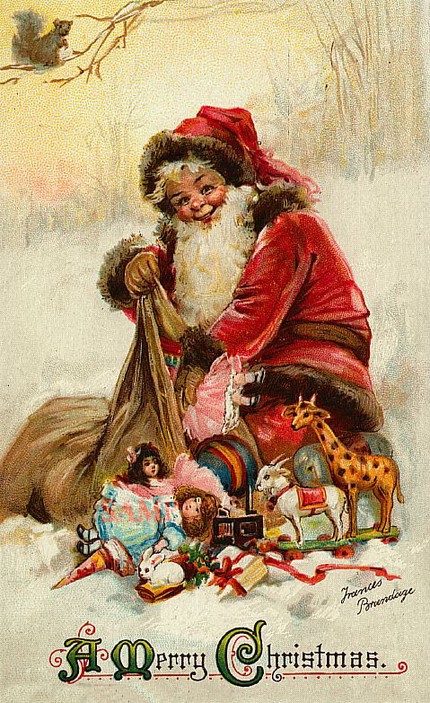
You better be good or Santa won't come: what we are teaching our children about possessions and worth


For the next four weeks, children all over the world will be hearing those words, "If you're not good, Santa won't come." I doubt it makes any difference to behaviour. The problem with threats like these is they're rarely (if ever) carried out. But it might just be making a difference to how people think about possessions and worth.

Imagine a child called Trudy. At the ripe old age of 7, Trudy has learnt that, no matter how badly behaved she is, those presents from Santa still arrive on Christmas Day. Furthermore, she knows that Jenny from next-door (also aged 7) usually gets less presents even though Jenny is a very well-behaved child and Trudy can be quite naughty at times. What is Trudy to make of this?

Or let's look at it from Jenny's perspective. She is told that the same Santa Claus brings presents to everyone. Furthermore, she is told that he only gives presents to the good girls or boys. So why is it that Trudy gets more presents than her? I doubt she would say it to herself in these terms, but on some subconscious level, might she not be wondering whether she is less worthy than Trudy in some unknown way? If she believes the Santa rhetoric, what else is she to think?

Let's fast-forward six years. Trudy and Jenny are now 13. Their belief in Santa has gone, but the messages they heard about Santa are still there. As any psychologist or counsellor knows, the messages we hear in childhood can affect us long after we have grown up - even if we recognise that those messages were false to begin with.

If you haven't already guessed, Trudy comes from a wealthier family than Jenny. So while they may not be coming from Santa, Trudy still has more and better possessions than Jenny does. Jenny knows it's not because Santa has placed Trudy on the "good list". But maybe, deep down, she still connects possessions to worth. Maybe she still feels like Trudy owns more things because she is more deserving.

Jump another 10 years. Trudy and Jenny have moved out of home and are sharing a flat together. Trudy finished uni and got a well-paid job. Jenny also has a job, but it's not nearly as well-paid as Trudy's is. By now, they've not only internalised the Santa message, but the many advertising messages they have heard through their lives that tell them, either implicitly or explicitly, that they should buy something because they deserve it.

Despite the fact that Trudy earns enough to save a little money and use her money to help others and give to charities, she spends it all on herself. Many of the things she buys, she will never even use. But that's okay (in Trudy's mind). It makes her feel good. She's become her own Santa, rewarding herself with possessions. The more things she owns, the more deserving she feels.

Jenny also buys lots of things. But because she doesn't earn as much money as Trudy, she puts it on credit. She is sliding further and further into debt. But she considers it a small price to pay for the sense of self-worth it gives her. She has finally made it onto Santa's "good list".

Jenny was never any less worthy than Trudy. She only felt that way because of what society told her. As adults we know that the amount of presents Santa brings says nothing about how "good" that child is. So how about we stop telling our children that. And how about we recognise the Santa messages we ourselves have internalised - and do our very best to get rid of them.

Our thinking about possessions and worth is damaging not just to ourselves, but to the earth. In order for this to change (and it does need to be changed) we first need to recognise how the messages we hear have influenced the way we think about possessions and worth. It's only then that we can get rid of them and replace them with something else. We need to come up with a new message, one where Santa doesn't reward the "good" kids, where we don't own things because we "deserve" them, but where a life well-lived is its own reward.

Sunday, June 6, 2010

Beauty Queen

I learnt when I was 17 that love was meant for beauty queens. And when I was 37, I learnt that I wasn’t a beauty queen because I didn’t have silky, shiny hair and pearly white teeth and full pouty lips and curly defined lashes and flawless skin. The good news was I could become a beauty queen if only I bought the right products. I guess if I couldn’t afford to buy the right products, I would just have to continue being ugly - and not as worthy.

I’m about to get quite personal here and share some thoughts that I’ve only recently admitted to myself. I feel less worthy because I’m not beautiful. When I talk to people (men and women) I sometimes get the feeling that they won’t want to know me because I’m not that beautiful or I don’t put enough effort into my appearance. When I compare myself to people who are more beautiful than me, I feel like I am worth less than they are and not nearly as interesting.

I shared this because I’m pretty sure I’m not the only one. And I don’t think it’s any surprise that I feel this way. Advertising agencies spend a lot of money trying to make me feel this way. Every time I turn on the TV, I’m bombarded with ads telling me that I can have silky, shiny hair and pearly white teeth, et cetera, et cetera. And the advertising agencies don’t just want to make you feel like you can have all these things. They want you to feel like you need to have all these things. No ad is going to come out and say you’re worth more if you’re beautiful. But the message is there nonetheless. Anyone who feels completely fine and worthy the way they are, and the way they look, is not going to spend a large amount on beauty products.

However, my feelings of worthlessness because of my looks got a lot worse when I joined the Pentecostal Church. On the face of it, this doesn’t appear to make much sense. Christian books, DVD, study groups, sermons and TV programs spend a lot of time telling woman that they are beautiful -- and that God thinks they are beautiful. So Christian women should think they’re beautiful, right? Well no. Because it’s still reinforcing the message that woman want to be beautiful. So if you’re not beautiful (even if God thinks you are) you feel sub-standard.

Christian marriage books (of which I read many before my divorce -- obviously they didn’t work) spend a lot of time telling women that men care about looks and they should put effort into their appearance. I was listening to a radio program where James Dobson was interviewing someone (sorry, I’ve forgotten his name) about how women should make the effort to look beautiful for their husbands. And ‘making the effort’ meant putting on make-up. James Dobson asked him whether women should wear make-up when they go to bed at night. I was relieved to hear the interviewee say no, but horrified at what came afterwards. James Dobson said that that really surprised him. The interviewee said that wearing make-up at night wasn’t good for the skin. In other words, the only reason why women shouldn’t be made up 24/7 is because it might make them look uglier in the long run.

Now I have nothing against women wanting to look nice for their husbands. And I think women like to make an effort sometimes, which often means putting on make-up. But I have a real problem with a world where women are expected to wear make-up. Because what make-up really is is a mask. It’s hiding the way we really look under a new improved version. And from a Christian perspective, it’s basically saying well the way God made me isn’t good enough. I need to look better.

One thing that makes this worse is that we are constantly seeing images of beautiful women. One hundred years ago, women were thought beautiful who wouldn’t even get a second glance now. I went to high school with a girl that everyone thought was beautiful. I think she’d be overlooked in a high school now. And I don’t think it’s because of fashions changing. I think it’s because our standards are so much higher. When just about every single woman we see in the media is made up to look their very best, we start to think that’s what beautiful is. And anything less than that isn’t good enough.

Not only that but we’re losing our appreciation of natural beauty. The type of beauty that can be found in very ordinary faces. We don’t see it because we’re too busy comparing the faces we see in real life with the made-up, altered faces we see on our TV screen. And we’re too busy hiding our natural beauty beneath a fortune of beauty products that the ads tell us we need to be beauty queens.

We’re also busy hiding imperfections. Beauty products are only part of it. There’s also cosmetic surgery. And if there is any imperfection on your body anywhere at all, there’s something you can do to get rid of it. If we continue to simply hide or remove imperfections, will we eventually reach the stage where any imperfection at all is automatically seen as devaluing? Will a woman’s worth be automatically rejected because she has a big nose?

About three years ago, my sons were talking about beautiful women. I can’t remember how they got onto the subject. At this stage, they were five and seven, which seems a strange age to be talking about beauty. But anyway, one of them (I think it was my youngest) said that the most beautiful woman at our church was the pastor’s wife. I don’t want to go into all the ways the pastor’s wife fails to live up to the ‘magazine ideal’ because that would be contributing to the problem. But let’s just say she’s not conventionally beautiful. But yet to my son, she was the most beautiful woman in church.

Last year, we were watching TV and some ad came on for a skin moisturiser. My son said to me “You should get that.” I felt like crying. Not because there was the insinuation there that I need a beauty product to be beautiful, but because his idea of beauty had changed. The media and the advertisements had finally influenced him.

I wonder what he’ll think of as beautiful in another ten years time. Will he have so many images of beautiful woman in his head that no-one in real life can compare? Will he fail to appreciate natural, ordinary beauty? Will he only look at women whose imperfections are hidden or corrected? Will he think his girlfriend isn’t making an effort if she doesn’t wear make-up? Will he think a woman’s worth is dependent on her beauty?

I hope not. And I like to think that I may influence the way both my sons see beauty. I hope that they can learn that someone doesn’t have to be perfect to be beautiful. And that a woman’s appearance is not the only thing that’s important. I hope they can appreciate and recognise the beauty in a person’s soul.

But then I can’t expect the media not to affect them at all. I know how much it has affected me.
The Beauty Myth: How Images of Beauty Are Used Against Women

Wednesday, December 23, 2009

Christmas is About Hope


Every Christmas, I go on a mini crusade against too much consumerism, too much Santa, too much stress and too little Christ. It’s not much of a crusade, because I’m just as guilty of those things as anyone else. Perhaps even more so. I guess I feel that, if I complain about it, it will somehow make me feel better. So as I shout out Merry Christmas to the world, I add a PS – But you’re getting it all wrong. Despite the fact that I’m getting it wrong myself.

Christmas should be a time of love, joy, peace and hope. I’ve turned into an excuse to point out the world’s faults.

I tend to point out the world’s faults quite a bit. I love to wag my finger at the world and say you’re getting it all wrong. I don’t do this because I need a hobby and finger-pointing seemed like an inexpensive one to choose. I do this because I do really believe that the world gets it terribly wrong sometimes. We place emphasis on materialism and success and downplay love and sacrifice. We judge things by scientific facts and evidence, and lose our ability to appreciate mystery and the sacred. But anyway, this is not meant to be another post about what’s wrong with the world.

And when I say the world has got it wrong, I include myself in that. I have it wrong just as much as the world does. Christ is so important in my life – at least that’s what I say – yet there are many occasions, each and every single day, when I fail to show that he is important. I do the things I don’t want to do and I fail to do the things I should be doing. The way I live is so far from the way I actually want to live.

When I look at how the world gets it wrong, I sometimes get angry. My children are pretty used to suddenly seeing me argue with the TV, when I’ve heard something on the news that I disagree with. Now, they’ve even started doing it themselves.

Sometimes, though, I just get depressed. This is particularly the case when it comes to my own faults. It is hard to continually feel as though I am failing in what I want to do.
Sometimes the situation just seems hopeless. The world has got it so far wrong that it seems impossible they will ever get it right. The problems are too big. People’s attitudes are too wrong. And my own life seems like a never-ending attempt to live the right way and never getting there. It just can’t be fixed. Why even bother trying?


But then Christmas comes and with it comes a message of hope. I’m sure you know that Christmas is not just about Santa and presents. But it’s not even just about Jesus being born. It’s about God’s Son being born. It’s about God taking on human form. Not so that He could have a short trip to Earth for a while to see what it was like. But because we were in a hopeless situation and we needed help. We were never going to get it right. We were never going to be good enough. So instead of giving up hope on the whole human race, God did something truly amazing. He sent his Son to give hope to the whole human race.

Recently, a boy was sent for psychological evaluation, after his teacher asked him to draw a picture of what Christmas meant for him and he drew a picture of Jesus on the cross. (I didn’t see this on the news, but I was arguing with my computer for a while. Why does the world get it so – oh, forget it.) At the risk of having my son sent in for psychological evaluation too, he made the same mistake. The other day he said, ‘Christmas is not about Santa. It’s about Jesus dying on the cross.’ My eldest son laughed in his ‘I’m an older brother and so much smarter’ laugh and said, ‘Christmas is not about Jesus dying on the cross. It’s about Jesus being born.’ But I told him that Christmas is about Jesus dying on the cross. It’s also about Jesus’ resurrection. Because the ending is what makes the beginning so special. At Christmastime, we must not only remember that Jesus was born, we must remember why He was born.


I have no idea how to fix the world’s problems. I have no idea how to put us on the right track again. I have no idea if we can be put on the right track. I don’t even know how to fix the problems in my own life. If I needed to work it all out, we may as well give us hope now. For I don’t know any solutions – beyond arguing with TVs and wagging my finger at the world.
There is one thing I do know though, one thing the Christmas story tells me, one thing the life of Jesus shows me and one thing Jesus’ death and resurrection makes real in my life – When things seem absolutely hopeless, God works in incredible and unimaginable ways to replace that hopelessness with hope.


Image details: Adoration by the shepherds, by Bronzino. From Wikimedia Commons. Image is in the public domain.

Thursday, October 1, 2009

Christianity and Consumerism

Recently, I was reading ‘The College Student’s Introduction to Christology’, by William P. Loewe, when I came across the following sentence:

Fourth and finally, we can also ask whether there is not a tendency on the part of the economic sector to spread out and rationalize every conceivable aspect of our human living as a commodity in the production of which a profit is to be had.


It does seem sometimes that consumerism has invaded every single aspect of our life. Whatever we need, whatever we want, whatever we hope for, there’s a product that can either help us obtain it or improve it. Christmas and Easter have practically been reduced to long shopping lists and busy malls. Even something as meaningful and important as the arrival of a new baby comes with a list of ‘things to buy’ – preferably new, preferably expensive – often containing a whole heap of things that aren’t even necessary, but new parents buy them anyway, because the magazines say we need them.

Even Christianity is not safe from the consumer bug. There used to be a time when all you needed was a bible and a church to follow Jesus. (And to be perfectly honest, you don’t actually need that. Many Christians around the world don’t have either. But they sure do help.) Now we have Christian books, CDs, DVDs, conferences, toys, computer games, bible covers, jewelry, t-shirts and even mints! Instead of the one bible, we have a multitude of versions, not to mention bibles on CD, MP3, software and iPhone applications. Not only is every single area of our life reduced to a consumer product, if you’re a Christian, you can find a Christian consumer product to suit every area of your life.

And we are often told we need these products. At the end of many sermons, you’ll hear the preacher urge everybody to buy this or that book, because it will bless you and really improve your Christian walk. You almost feel like you’re a bad Christian if you don’t immediately rush to the stalls. Christians are kind of expected to have more than one bible version, with a bible cover, Christian books and Christian CDs. I remember hearing one Christian say that he had never been to the local Christian bookstore. The looks of amazement on people’s faces. What? You’ve never been to the Christian bookstore. But you’re a Christian. Shouldn’t you be out there buying Christian products?

Now I’m not pointing the finger at anyone. When it comes to Christian products, I have more bibles, Christian books and Christian CDs than anyone I know. Just before writing this post, I was going through a book catalogue circling what I wanted to buy. And I don’t think there’s anything wrong with that. (Well, I hope there isn’t. Because if there is, I’m in trouble.) But I do think there’s something wrong with turning every single little thing into a Christian product. Do we really need Christian mints? Seriously.

It can also become a problem when we think we need to have all these consumer products. There is absolutely no book or DVD or CD that we absolutely must get. It can also become a problem if we think buying things makes us a good Christian. It doesn’t. Nobody is going to be judged by how much money they spend at the Christian bookstore.

And maybe instead of telling people, ‘Oh, you really should read this book,’ we’d be better of pointing to the bible and saying, ‘You really must do what’s in that book.’

AddThis

Bookmark and Share

Blog Patrol