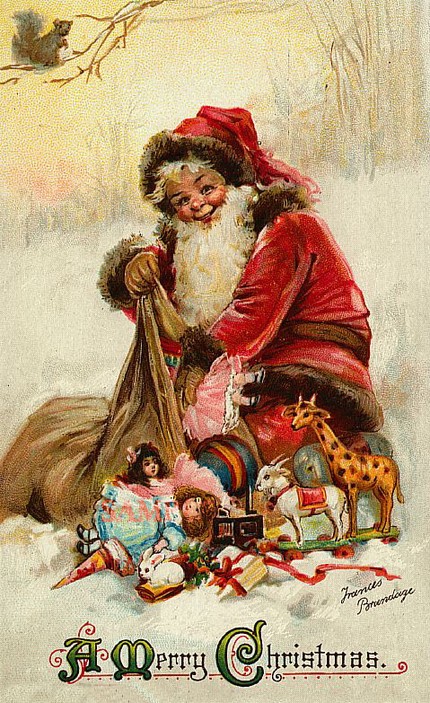
Showing posts with label Santa. Show all posts

Friday, December 2, 2011

You better be good or Santa won't come: what we are teaching our children about possessions and worth


For the next four weeks, children all over the world will be hearing those words, "If you're not good, Santa won't come." I doubt it makes any difference to behaviour. The problem with threats like these is they're rarely (if ever) carried out. But it might just be making a difference to how people think about possessions and worth.

Imagine a child called Trudy. At the ripe old age of 7, Trudy has learnt that, no matter how badly behaved she is, those presents from Santa still arrive on Christmas Day. Furthermore, she knows that Jenny from next-door (also aged 7) usually gets less presents even though Jenny is a very well-behaved child and Trudy can be quite naughty at times. What is Trudy to make of this?

Or let's look at it from Jenny's perspective. She is told that the same Santa Claus brings presents to everyone. Furthermore, she is told that he only gives presents to the good girls or boys. So why is it that Trudy gets more presents than her? I doubt she would say it to herself in these terms, but on some subconscious level, might she not be wondering whether she is less worthy than Trudy in some unknown way? If she believes the Santa rhetoric, what else is she to think?

Let's fast-forward six years. Trudy and Jenny are now 13. Their belief in Santa has gone, but the messages they heard about Santa are still there. As any psychologist or counsellor knows, the messages we hear in childhood can affect us long after we have grown up - even if we recognise that those messages were false to begin with.

If you haven't already guessed, Trudy comes from a wealthier family than Jenny. So while they may not be coming from Santa, Trudy still has more and better possessions than Jenny does. Jenny knows it's not because Santa has placed Trudy on the "good list". But maybe, deep down, she still connects possessions to worth. Maybe she still feels like Trudy owns more things because she is more deserving.

Jump another 10 years. Trudy and Jenny have moved out of home and are sharing a flat together. Trudy finished uni and got a well-paid job. Jenny also has a job, but it's not nearly as well-paid as Trudy's is. By now, they've not only internalised the Santa message, but the many advertising messages they have heard through their lives that tell them, either implicitly or explicitly, that they should buy something because they deserve it.

Despite the fact that Trudy earns enough to save a little money and use her money to help others and give to charities, she spends it all on herself. Many of the things she buys, she will never even use. But that's okay (in Trudy's mind). It makes her feel good. She's become her own Santa, rewarding herself with possessions. The more things she owns, the more deserving she feels.

Jenny also buys lots of things. But because she doesn't earn as much money as Trudy, she puts it on credit. She is sliding further and further into debt. But she considers it a small price to pay for the sense of self-worth it gives her. She has finally made it onto Santa's "good list".

Jenny was never any less worthy than Trudy. She only felt that way because of what society told her. As adults we know that the amount of presents Santa brings says nothing about how "good" that child is. So how about we stop telling our children that. And how about we recognise the Santa messages we ourselves have internalised - and do our very best to get rid of them.

Our thinking about possessions and worth is damaging not just to ourselves, but to the earth. In order for this to change (and it does need to be changed) we first need to recognise how the messages we hear have influenced the way we think about possessions and worth. It's only then that we can get rid of them and replace them with something else. We need to come up with a new message, one where Santa doesn't reward the "good" kids, where we don't own things because we "deserve" them, but where a life well-lived is its own reward.

Friday, December 11, 2009

Make Room for Christ at Christmas - or - Why Santa Should Be Sent to the Dog Kennel


Yesterday, I posted one of my short stories called No Room. Although I’m pretty sure the historical details aren’t entirely correct, I wrote it that way because I wanted to write a story about someone who finds it hard to make room for Christ at Christmas.

In Bethlehem, over 2000 years ago, it was hard to find a place for the Baby Jesus to be born. In the 21st Century, we are still finding it hard to make room for Jesus in our lives.

Ironically, one of the hardest times to make room for Jesus is at Christmas, the time when we should most be thinking of him. Instead of preparing a room and welcoming him as an honored guest, we treat him as an inconvenience – and one we don’t have time for right now.

Everybody is so busy at Christmas. There’s the Christmas cards to be sent, the Christmas shopping to be done, the Christmas decorations to be put up, the Christmas lunch to be prepared, the Christmas presents to be wrapped.

Sometimes we’re so busy, we can’t even keep the Christ in the Christmas things we are doing. That’s Xmas cards, Xmas shopping, Xmas decorations, Xmas lunch and Xmas presents. I guess ‘X’ is less time-consuming than Christ.

Well we have to save time somewhere and nothing else can go, can it? If we didn’t send out Christmas cards, people would think we didn’t care about Christmas. If we didn’t put up an amazing outdoor Christmas light display, we wouldn’t be being very festive. To tell people we don’t want to exchange gifts would show a distinct lack of Christmas spirit. And perhaps a cooking a smaller lunch (with say enough food for the afternoon, not for the week) is possible, but it’s Christmas and you need to celebrate at Christmas time.

We’ll get rid of Christ easily enough, with the excuse that there’s not enough time for him. But there’s no way we’ll get rid of anything else that is related to the season.

Now to be fair, many people will fit in a church service somewhere between opening presents and eating lunch. They might even make room for a Christmas carol or two. (Although it is hard to find time to sing the carols about Jesus, when there’s so many songs about Santa to be sung.)

But we’re hardly treating his as an honoured guest. In Bethlehem, there was no room for Jesus in the inn, but they found a space for him in a manger, with the animals. Nowadays, there’s no room for Jesus at Christmas, except for a small parcel of time between 10 am and 11 am on Christmas morning.

And yet nobody seems to have a problem making room for Santa.

The next time you see a nativity scene, take a good look at it. (Presuming you do see a nativity scene. They’re becoming somewhat endangered lately. Better make it a good, long look. It may be the last time you ever see one.)

Anyway, take a good, long look and ask yourself where Jesus is placed during your Christmas time. Is he squeezed in between the donkey and cow (or Santa and presents), placed in a manger because that’s the only place he will fit, without it inconveniencing you? Or he is given the best room and welcomed as an honoured guest?

And may I suggest, if you are finding it difficult to make room for Jesus this Christmas, take Santa out of the best guest room and make him sleep with the animals instead. Relegate him to the dog kennel. You have a more important guest coming you need to make room for.

We can all make room for Jesus. But it may mean realising that some things are just not that important.


Image Details: Cappella Scrovegni a Padova, Life of Christ, Nativity, Birth of Jesus, Giotto di Bondone (1267-1337). Taken from Wikimedia Commons. Image is in the public domain.

AddThis

Bookmark and Share

Blog Patrol