Tuesday, January 22, 2013

Accepting women's nakedness - Eve and the Garden of Eden


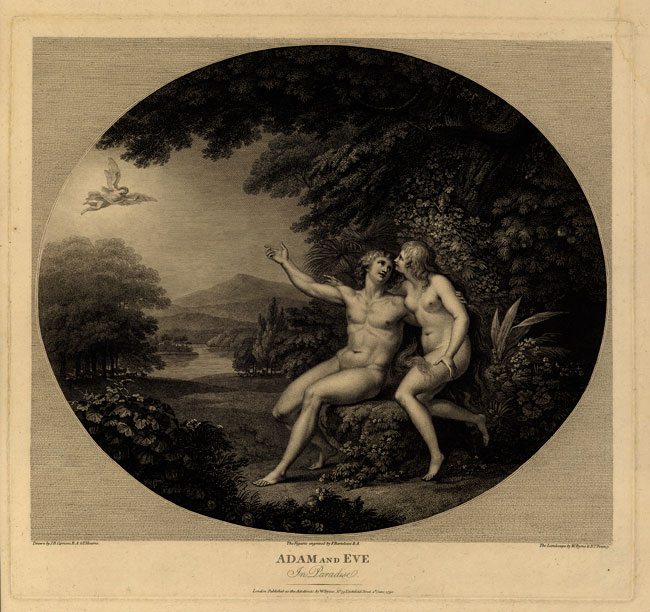
Eve was naked in the Garden of Eden.

We're used to those pictures where Adam and Eve have appropriately placed fig leaves. But until they ate from the forbidden fruit, Adam and Eve would not have been wearing them. They would have been well and truly naked.

And not naked, in a 'provocative, over-sexualised, look at me and ogle me' way. Naked in a 'this is who I am, exactly as God intended' way.

Unfortunately, it wasn't too long until they ate from the forbidden fruit. It was only after this that they tried to cover themselves with fig leaves. It was also after this, that they were removed from the garden and God made them coverings of animal skins. Remember, that Adam and Eve had already tried to cover themselves. And remember that God was quite happy for them to be naked before they ate the forbidden fruit. When God provided animal skins, I don't believe he was saying that they shouldn't be naked.

I should quickly clarify that I'm not about to suggest we all start stripping off our clothes. What I am suggesting is that maybe we need to get a lot more comfortable with women's nakedness - not in the sense of wearing no clothes, but of accepting all aspects of a woman's body.

Imagine for a moment that they didn't eat the forbidden fruit, that Eve remained in the Garden of Eden in her naked state.

She would have gotten her periods, had babies, breastfed. She may have even talked about her vagina! I imagine during the birth of her babies, it may have come up in conversation. She would have grown old. Her tummy would not have been so flat anymore. Her breasts would not have been so perky. She would have gotten wrinkles and grey hairs.

And I kind of think Adam and God would have been cool with that. In fact, I kind of think that if Adam had even thought of complaining, God would have been very quick to tell him, I made her that way.

This is no airbrushed, photoshopped version of Eve's nakedness. It's real nakedness. It's nakedness where nothing about a woman has to be hidden away. It's a nakedness where a woman's natural ageing processes and natural nurturing functions are on view and accepted.

We're a long way from the Garden of Eden.

Last year, a US politician was banned from addressing the Michigan House of Representatives after using the word 'vagina'.

Last week, a woman was told to stop breastfeeding her baby at a public pool. Sunrise host, David Koch, said women should be 'discreet' and 'classy' when breastfeeding in public.

Yesterday, Mama Mia gave a thumbs-up to Nigella Lawson for refusing to allow her tummy to be photoshopped out. (http://www.mamamia.com.au/social/nigella-lawson-and-a-big-photoshop-win/). What's sad about this is the fact that they even want to photoshop tummies out. 
But then someone refusing to be photoshopped is news. The large amount of photoshopping that goes on every day (removing wrinkles, tummies and anything else considered unattractive) is not. It's too common to rate a mention.

We live in a world where there's quite a large amount of women's flesh on show. But it's not real women's flesh. It's not wormen-affirming flesh. It's flesh where all the faults have been removed. It's flesh that is well-presented and 'perfected'. It's flesh that's there to be looked at. (And I use the word 'flesh' intentionally here, because that's what it seems like - that women are just flesh.)

And if we dare to show women's bodies in a way that shows they're not flesh, that they actually are designed for something so much more important than being looked at, we are told to do it in a way that's classy and discreet - presumably not to offend anyone who might be 'looking' at us.

I suspect that Adam liked looking at Eve's body. And I suspect God did too. But it was an appreciation borne out of seeing Eve as she really was, and understanding her as a person and not just something to be ogled. It was an appreciation that could accept Eve in her true naked form.

We can't return to the Garden of Eve. But may we all learn to accept women's nakedness a little bit more - without necessarily taking off any clothes J  

Saturday, January 19, 2013

Religious sensitivities and anti-discrimination laws


A new bill by the Australian Labor Party will give religious organisations in Australia the right to discriminate against those who might cause "injury to the religious sensitivities of adherents of that religion."

It seems that the press wanted to present this in as controversial a way as possible, with many news outlets reporting that religious organisations were free to discriminate against those they considered 'sinners', which is not the actual wording used - and makes no sense at all in a Christian context, as we are all sinners.

However, one might well ask what does "injury to the religious sensitivities of adherents of that religion" actually mean?

I am a Christian. And I can think of no person whose employment would cause injury to my religious sensitivities. As a Christian, though, who believes God's love and compassion extends to all people, I do feel my religious sensitivities may be injured should someone be refused employment on the basis of sexuality, gender, marital status or religion.

The same stories that used the word 'sinners' also said:

"Under current exemptions to legislation, religious groups can reject employees for being gay, single parents or living "in sin"." (Read more: http://www.news.com.au/breaking-news/national/sinner-story-a-beat-up-christian-lobby/story-e6frfku9-1226554925167#ixzz2IPSaHuB6)

So are these the type of people who would injure 'religious sensitivities'? I would say no. But at the same time, I fear that it is these kinds of people that will be discriminated against.

Jim Wallace from the Australian Christian Lobby explains it differently. He says it's not a matter of vetting people, but of employing people who share the same beliefs. He gives the example that an environmental organisation would not employ someone who was an 'ardent logger'.

The difference is, of course, that environmental organisations (quite rightly) are subject to discrimination laws.

And however it's painted, in practice, I fear it's going to be used mainly as an excuse refuse employment to homosexuals.

And quite frankly I don't think that's right and I don't think that's Christian. For a start, why is that many (certainly not all, but many) Christian churches focus on this one group of people? They'll employ just about anybody and accept just about anybody - except for homosexuals.

I have heard many Christians say that a person cannot be a Christian and a homosexual. Why not? Even if they do believe it's a sin - there's lots of sins mentioned in the bible. I think it's safe to say that we're all guilty of at least one of them - and I include in there the sins mentioned as abominations. Lying is an abomination. Women wearing men's clothing is an abomination. There's lots of them. (For a full list of them all, go here: http://richardwaynegarganta.com/abomination.htm)

I'm pretty sure that there aren't too many people who are being refused employment by a Christian organisation for cheating or lying or oppressing the poor. We're perfectly willing to employ those people. But homosexuals, no, can't be done. That would offend our religious sensitivities.

And I do understand that some Christian organisations (such as schools) want to employ people who share those Christian beliefs. That does make sense. But if it ends up getting used mostly as an excuse to discrimination against people, then that's not right.

We believe in a God who has created us all and loves us all. We have the example of the Good Samaritan to show that even the people we detest may end up being the ones who do a lot better job of loving their neighbour than the 'right' people do. We have what might be considered an anti-discrimination verse in Galatians 3:28: ' There is neither Jew nor Gentile, neither slave nor free,nor is there male and female, for you are all one in Christ Jesus.'

We also have a lot of bible verses and passages that tell us not to be judgmental, Matthew 7:1-5 being just one of them:

“Do not judge, or you too will be judged. For in the same way you judge others, you will be judged, and with the measure you use, it will be measured to you.
“Why do you look at the speck of sawdust in your brother’s eye and pay no attention to the plank in your own eye? How can you say to your brother, ‘Let me take the speck out of your eye,’ when all the time there is a plank in your own eye? You hypocrite, first take the plank out of your own eye, and then you will see clearly to remove the speck from your brother’s eye."

Christians should be the people who accept others, the people who love others, the people who are least likely to judge others. We should be the least likely to discriminate, not the legal exception to anti-discrimination laws.  

I do realise that the press has probably not done the best job in reporting this story. Controversial stories sell more papers - I should know, I bought one myself when I saw the front page of The Canberra Times. And I also realise that there are many religious organisations who do not discriminate based on age, gender, sexuality, race or religion.

However, I also wonder how the average Australian sees the church at this time. Do they see a church that is accepting and welcoming, that represents a God that loves them? Or do they see a church that wants to exclude people and that dislikes certain groups of people? And which one really is more representative of the God who created everyone, who loves everyone and his son, Jesus Christ, who died for everyone?


(Picture taken from "Religious groups free to discriminate" on www.smh.com.au -  http://www.smh.com.au/opinion/political-news/religious-groups-free-to-discriminate-20130115-2crlw.html)

Monday, January 14, 2013

Praise and persecution


On Palm Sunday, Jesus rode into Jerusalem on a donkey, as a large group of people praised him. Just one week later, in the same town, a large group of people were calling for his crucifixion. Quite possibly, many of the people in the original group were there in the latter group as well. Just one week and everything changed. What happened?

I think what happened is that those people who were praising Jesus as he rode in a donkey were not only praising Jesus, they were praising what they expected him to be. They thought he was going to get rid of the Romans. They thought that he was going to gain Jewish independence. They had plans for the Messiah and thought Jesus was probably a pretty good fit for those plans. They thought that with the Messiah on their side, the Romans didn’t stand a chance.

I imagine quite a few people would have been shocked to hear that Jesus had been arrested. But perhaps they were still kind of okay with it. I mean, Jesus wasn’t following their plan exactly the way they had decided he should, but they could handle a few slight detours along the way. Maybe he was planning to use his arrest to overthrow the Romans and put the Jews in charge again? But he didn’t. Instead, he meekly submitted to their authority.

When Pontius Pilate said he would release one of the prisoners, I’m pretty sure that by then they realised that Jesus wasn’t going to follow the agenda at all. They would have known (or thought they knew) that any real Messiah wasn’t going to gain his release by the Romans agreeing to let him go. That’s not part of the plan. No way. So perhaps right about then they decided that because this Jesus guy wasn’t following the agenda, that he wasn’t really the Messiah at all. I mean the real Messiah would do what they wanted him to do, right? So what to do with Jesus, this guy who ‘pretended’ to be the Messiah, but failed to follow their rules? May as well crucify him. He probably deserves it for giving everyone the wrong idea.

But Jesus was the Messiah. Just because he didn’t do things the way people expected him to didn’t mean he wasn’t the right guy. He just did things his way (and God’s way) rather than their way. He wasn’t out to meet anybody’s agenda. He had his own agenda to take care of.

Sometimes I think we do the same thing now. We have our own ideas about what God should do and when he should do it. We expect God to follow our agenda. But God doesn’t always go along with our plans. He has his own plans. And sometimes perhaps we may wonder whether God’s actually in something at all. I mean if it doesn’t go the way we expect it to, maybe God’s not really in it, right? But just because things don’t go the way we want, doesn’t mean that God’s not there.

There’s a quote from Abraham Lincoln that I absolutely love. It goes like this: “Sir, my concern is not whether God is on our side; my greatest concern is to be on God's side, for God is always right” The reason I love that quote so much is because it draws our attention to the fact that we shouldn’t be making our plans and expect God to go along with them. We should instead be making sure we’re following God’s plans. It also reminds us that just because we decide to do something and call on God to help us doesn’t necessary mean that God is on our side.

We can’t decide to go to war and expect God to sign up as a valuable recruit.  Instead, we should be looking to sign up as recruits in his army. We need to fight against the things that he tell us to fight against, like poverty. We need to fight for the people that he tells us to fight for, like the weak and the marginalised. We need to try and work towards God’s plans succeeding, rather than making our own plans and expecting God to help us achieve them.

Palm Sunday is coming up in a couple of days. It’s generally a time for remembering the praise that people gave Jesus as he rode in on his donkey. But perhaps it should also be a time for thinking about whether we’re following Jesus as he really is, or Jesus as we want him to be. Are we making sure we’re on God’s side? Or are we making plans and just expecting God to be on our side?


AddThis

Bookmark and Share

Blog Patrol